

A Brief History of
The American Prison System
How did the United States become the country with almost six times more people behind bars than anywhere else on earth? And why does that burden fall so unevenly on Black, Indigenous, and brown communities? The answers to these questions have deep roots in our nation's history, tracing a pathway from enslavement to modern day incarceration. This brief follows the arc of America's prison system: how it was built, who it was built to benefit, and how understanding these legacies can help us create better ways to protect our communities from harm.
Watch: The History of the Prison System
A Revolutionary Form of Punishment
Today, incarceration — or the use of imprisonment as a punishment for crime — appears to be an almost natural part of our social and legal infrastructure.1,2 However, the use of prisons as a punishment is a relatively recent development, and one that has co-evolved in the US alongside our nation's racial politics. In early colonial America, capital and corporal punishment — adapted from English common law — were the primary tools for addressing socially unacceptable behavior. Because community was central to life in this time, punishments like banishment, stocks, and whippings sought to shame or isolate people. Small jails known as "gaols" existed primarily as debtors prisons,3 confinement for military and political prisoners,4 and short-term holding cells for those awaiting trial.5 It was not until after the American Revolution that the first state prisons were established to hold people longer-term.6 Importantly, these early prisons frequently served as both jails and workhouses — a practice that would come to profoundly shape the evolution of the criminal legal system we have today.7,8
America's unique carceral system — ironically borne out of a revolution fought in the name of freedom from political oppression — transformed imprisonment from a waiting room before punishment into the primary form of punishment itself.
"State Prisons should be so constructed that even their aspect might be terrific and appear like what in fact they should be, dark and comfortless abodes of guilt and wretchedness."
- Dr. Daniel Rose, Maine State Prison Warden (1823)
The Legacy of Slavery in American Prisons
Early prisons in the US primarily used inmate labor to keep operations functioning efficiently. In some cases, however, legal codes like those from the Northwest Ordinance allowed for forced labor among people convicted of crimes.9 In 1865, the 13th Amendment solidified this practice at the federal level, outlawing slavery "except as a punishment for crime."10 In what came to be known as the "criminal-exception loophole," southern plantation owners began lobbying for the creation of Black Codes that penalized things like gun ownership, vagrancy, and unauthorized movement among people recently freed from slavery.11 With few legal protections, states imprisoned generations of Black Americans on petty offenses, then leased them back to plantations through convict-leasing programs that lasted well into the 20th century.12,13 Today, these policies have been outlawed, but their legacies continue — both in the racial make-up of America's prisons and the use of people in prison as un- or underpaid labor, often in dangerous conditions.
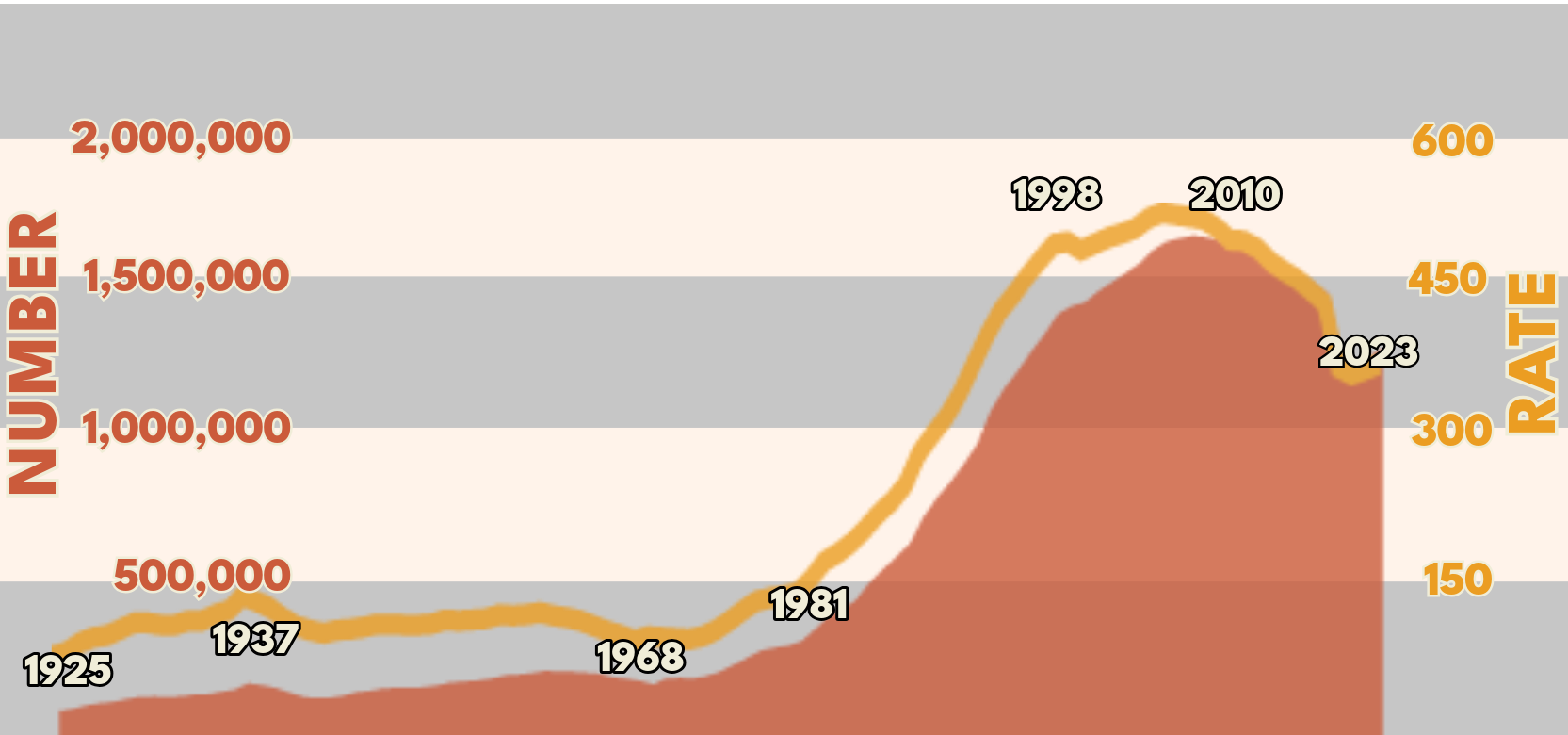
While the Black Codes shaped who was incarcerated in the US, social and political changes in the wake of World War II dramatically reshaped how many people we incarcerate, and for how long. By the end of the 20th century, incarceration rates had more than tripled, with young Black men disproportionately targeted for imprisonment.14 How did this come to pass?
Incarceration as a Strategy for Power and Profit
As the civil rights movements took shape in the 1960s and tensions between police and Black Americans rose, southern political strategists began to advance an electoral campaign known as the "Southern Strategy." This strategy sought to mobilize white working class Americans by exploiting fear around crime, deliberately linking it to race.15 In the years to follow, "urban crime," a newly coined dog-whistle, was used to justify increased surveillance and policing of Black and brown neighborhoods, deepening existing disparities in police contacts, arrests, and incarceration.16,17,18 In 1965, President Lyndon B. Johnson declared a "War on Crime"19 and three years later oversaw the passage of laws, including the Omnibus Crime Control and Safe Streets Act, which provided $300 million to "modernize" the criminal justice system across the country. This provided police, especially in low-income and urban areas, with militarized equipment and expansive surveillance technologies.20 That same year, the Supreme Court in Terry v. Ohio enabled law enforcement to use "stop and frisk," a practice that allows police to question or search anyone they deem suspicious.21 Combined, these policy changes dramatically expanded the resources, tools, and administrative power of police to detain and imprison poor people, and people of color.
While these policies helped drive the rise in incarceration rates among Black and brown communities, some of the most significant shifts came the following decade. At the start of the 1970s, the US had 511 prisons. In the decades to follow, state and federal governments would invest more than $20 billion in building over 1,000 additional facilities.22 These expanded facilities would shortly come to be filled amid a wave of new and more aggressive possession laws. Such laws criminalized drug and gun possession with harsh sentences and were often used strategically to police and imprison Black and brown Americans, despite being "race neutral."23
Restricting parole became another tool in the expansion of incarceration. Maine became the first state to abolish parole in 1975, and over the following decades more than a dozen states followed.24 Beyond keeping people incarcerated longer, parole restriction carried political weight. The 1988 presidential campaign weaponized a Massachusetts furlough program — a form of temporary release connected to parole — to stoke racial fear around crime. Political strategist Lee Atwater admitted the strategy was deliberately designed to link crime to race for electoral gain.25
That political climate produced concrete policy. The 1994 Federal Violent Crime Control and Law Enforcement Act allocated $9.7 billion for prison expansion and incentivized states to keep people incarcerated longer by requiring them to demonstrate increases in time served as a condition of receiving federal funds. It codified and accelerated increased sentencing policies already underway: 100-1 sentencing disparities for crack cocaine, mandatory minimums, truth-in-sentencing requirements, three-strikes laws, and life without parole that fell disproportionately on Black and brown communities.26,27
The massive expansion of people in prison created a new political problem. State facilities were overcrowded, and building new ones required voter-approved bonds that were difficult to pass. Private prison companies offered a solution, contracting with governments to build and operate facilities outside the bond process, funded directly through state budgets. Their contracts were structured to guarantee profit: states paid per bed per day, and occupancy guarantees meant governments had a financial incentive to keep beds filled. The first fully private adult prisons opened in Texas in 1988. By the mid-1990s, private prison companies were lobbying actively for policies that kept their facilities full.28,29
Importantly, there is little evidence to suggest that the massive expansion of the prison system in America has done much to reduce crime. A 2014 study by the National Research Council on the causes and consequences of incarceration in America highlighted that while patterns of crime reduction associated with incarceration are highly variable, "the evidence...indicates that the large increase in incarceration rates probably did not substantially reduce crime" in America. The report concluded, moreover, that the social harms caused by the prison system are substantial, including loss of work, increased poverty, and tearing apart the community ties that actually do keep people safe.30
What Comes Next?
After decades of deliberate expansion of the US prison system in the late 20th century, the number of people behind bars in the US has leveled out in the past decade. The patterns we have explored here, however, suggest that the policies driving incarceration — particularly for people of color — show no signs of reversing. The increasing rate of incarceration among women, the continued exploitation of inmate labor, the growth of for-profit prisons, and the rampant detention of people who came to this country seeking safety and a better life show that the use of prisons and detention centers as tools of our legal system has not changed.
America's prison system did not happen by accident, and it won't change by accident either. But systems built by people can be changed by people. When we understand how America's prison system was designed, who it was built to control, and who profits from keeping it running, we are better equipped to imagine something different.
Permanent Commission on the Status of Racial, Indigenous, and Tribal Populations. (2024). State of Racial Disparities in Maine.
Permanent Commission on the Status of Racial, Indigenous, and Tribal Populations. (2025). Restorative Justice: An Examination.
Prison Policy Initiative. Maine Profile.
National Research Council. (2014). The Growth of Incarceration in the United States: Exploring Causes and Consequences.
Barak, G., Flavin, J., Leighton, P. (2001). Class, Race, Gender, and Crime: Social Realities of Justice in America. Roxbury Publishing Company, LA.
| Notes |
|---|
| 1. Davis, A. (2003). Are prisons obsolete? Seven Stories Press, NY. |
| 2. Hirsch, A. J. (1982). From Pillory to Penitentiary: The Rise of Criminal Incarceration in Early Massachusetts. Michigan Law Review, 80(6), 1179–1269. |
| 3. Gaols were used to pressure debtors who could afford to repay their debts to do so. Hirsch, A. (1982). |
| 4. In the American Northeast, this was primarily tribal members captured in conflicts. Hirsch, A. (1982). |
| 5. Rubin, A. (2018). History of the Prison. In The Handbook of Social Control (pp. 277–292). Wiley & Sons, Ltd. |
| 6. Maine's first state prison was established in 1824 in Thomaston and included 50 solitary confinement cells built underground. See more at https://digitalcommons.library.umaine.edu/mainebicentennial/122/ |
| 7. Rubin, A.T. (2018). History of the prison. |
| 8. Wacquant, L. (2007). From Slavery to Mass Incarceration: Rethinking the "race question" in the US. In Race, Law, and Society. Routledge Press. |
| 9. The Northwest Ordinance of 1787. https://www.archives.gov/milestone-documents/northwest-ordinance |
| 10. U.S. Const. amend. XIII. |
| 11. Rubin, A.T. (2018). History of the prison. |
| 12. Davis, A. (2003). Are prisons obsolete? |
| 13. Slavery by another name. PBS. https://www.pbs.org/tpt/slavery-by-another-name/interactive-timeline/ |
| 14. Aviram, H. (2014). Are private prisons to blame for mass incarceration and its evils? Prison conditions, neoliberalism, and public choice. Fordham Urban Law Journal, 42(2). |
| 15. Inwood, J.F.J. (2015). Neoliberal racism: The 'Southern Strategy' and the expanding geographies of white supremacy. Social & Cultural Geography, 16(4), 407–423. |
| 16. Dubber, M.D. (2001). Policing possession: The war on crime and the end of criminal law. The Journal of Criminal Law & Criminology, 91(3). |
| 17. Hinton, E. & Cook, D. (2021). The mass criminalization of Black Americans: A historical overview. |
| 18. Aviram, H. (2014). Are private prisons to blame for mass incarceration and its evils? Prison conditions, neoliberalism, and public choice. |
| 19. Johnson's original aims were to address the root causes of violence and crime by funding education and addressing poverty. Political pressure — including from within his own party — however, resulted in significantly more aggressive tactics being used. |
| 20. Hinton, E. & Cook, D. (2021). The mass criminalization of Black Americans: A historical overview. |
| 21. Thompson, H.A. (2010). Why mass incarceration matters: Rethinking crisis, decline, and transformation in postwar American history. Journal of American History, 97(3). |
| 22. Eason, J. (2017). Prisons as Panacea or Pariah? The Countervailing Consequences of the Prison Boom on the Political Economy of Rural Towns. Social Sciences, 6(7). |
| 23. Dubber, M.D. (2001). Policing possession: The war on crime and the end of criminal law. |
| 24. Renaud, J. (2019). Grading the parole release systems of all 50 states. Prison Policy Initiative. |
| 25. Mendelberg, T. (2001). The Race Card: Campaign Strategy, Implicit Messages, and the Norm of Equality. Princeton University Press. |
| 26. National Research Council. (2014). The Growth of Incarceration in the United States: Exploring Causes and Consequences. |
| 27. Rosenfeld, R, et al. (2019). The 1994 Crime Bill Legacy and Lessons. Council on Criminal Justice. |
| 28. Aviram, H. (2014). Are private prisons to blame for mass incarceration and its evils? Prison conditions, neoliberalism, and public choice. |
| 29. Bauer, S. (2018). American prison: A reporter's undercover journey into the business of punishment. |
| 30. Travis, J., Western, B., & Redburn, F. S. (2014). The growth of incarceration in the United States: Exploring causes and consequences. |